On-premise computer-vision grading & sizing for corn flakes
Prepared for Sri Bhagyalakshmi Agro Foods by Svayou
● 660 flakes graded on your sample● Runs inside your plant
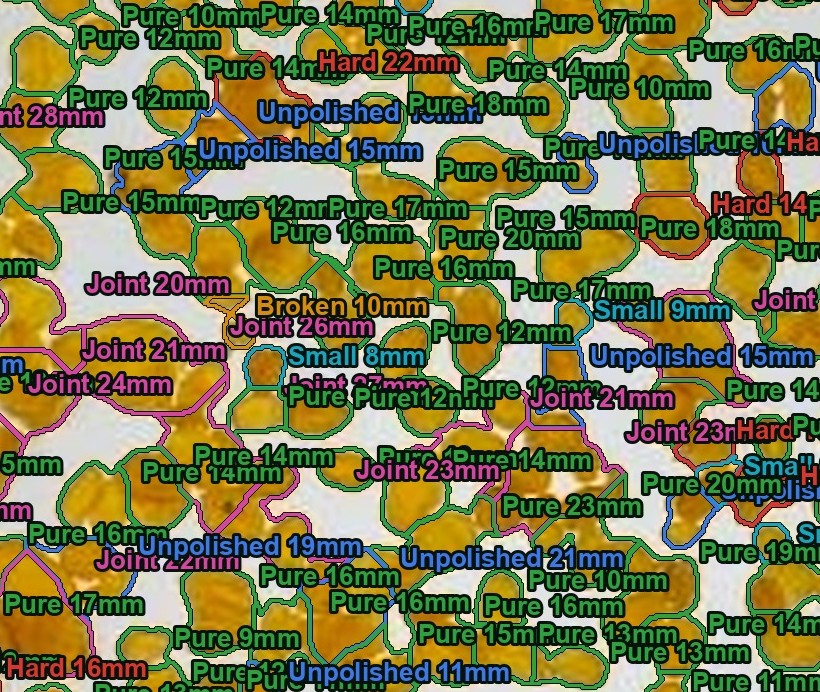
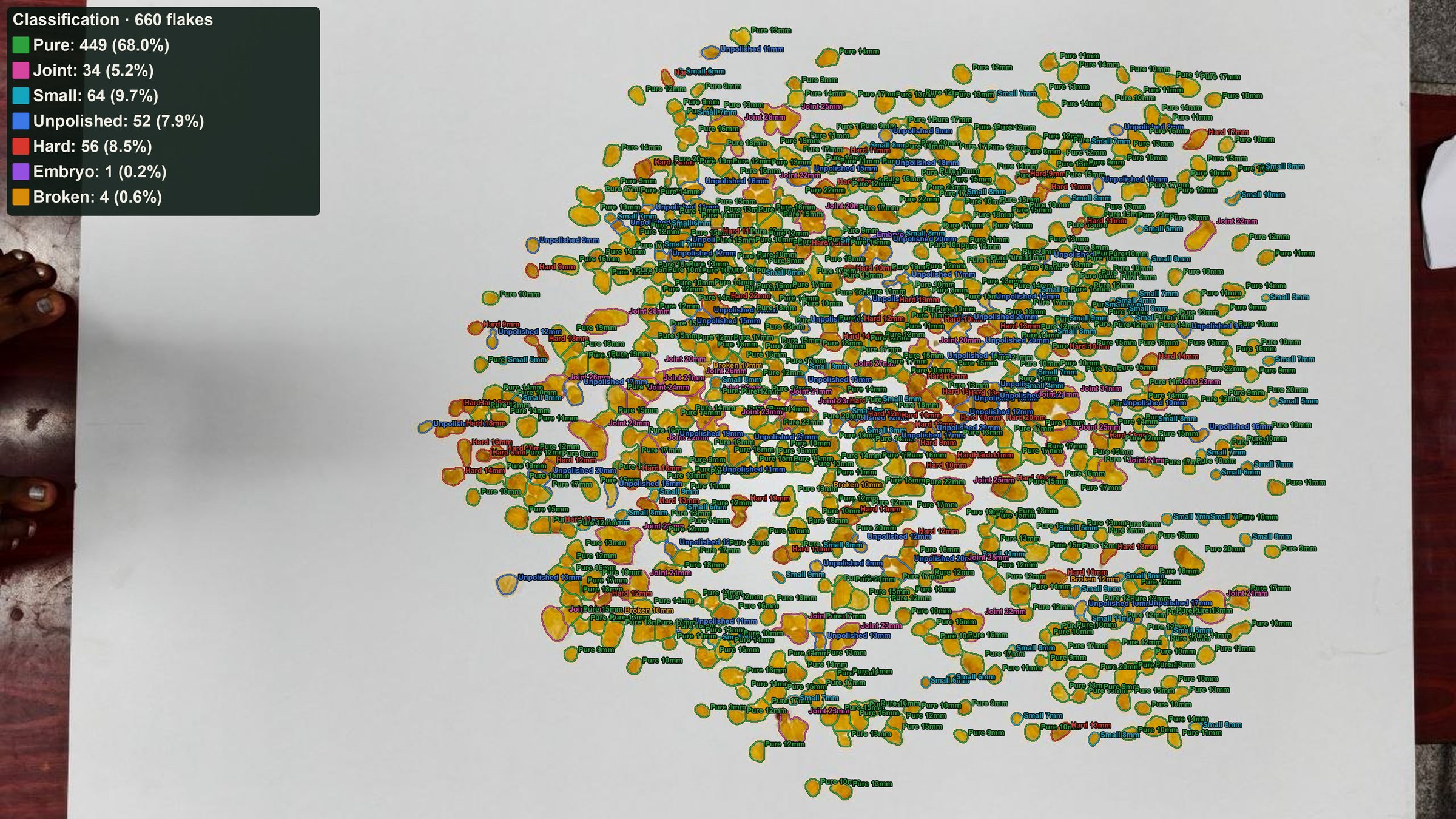
Your 19 Oct sample — every flake detected, measured and graded
The objective
Make grading objective, repeatable and fast
Today a batch is accepted or rejected on a manual, subjective judgement. FlakeGrade replaces the human estimate with measurement — every flake, every time.
Classify
Every flake, one of 7 grades
Each individual flake is assigned a grade from your master standard — no sampling by eye.
Size
Real dimensions in mm
Length, width and equivalent diameter for every flake, from a calibrated camera.
Decide
Accept / reject, with evidence
Batch grade mix vs your master, run through your rule — with a full per-flake audit trail.
FlakeGrade · Svayou
Your standard
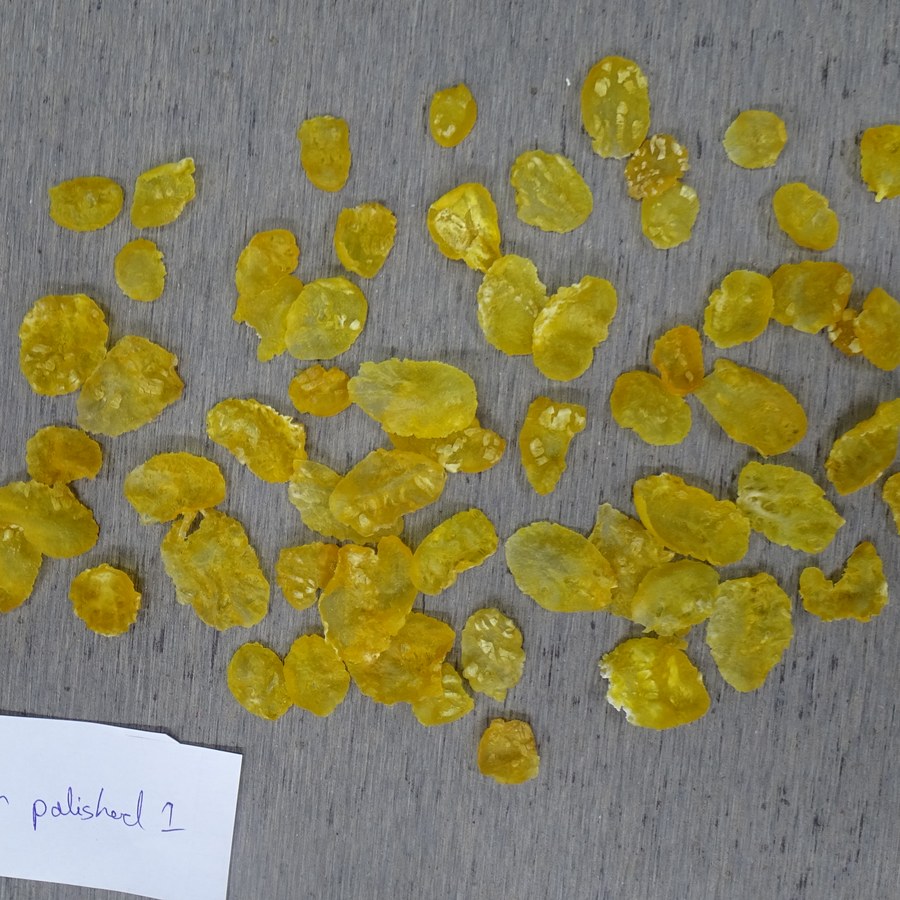
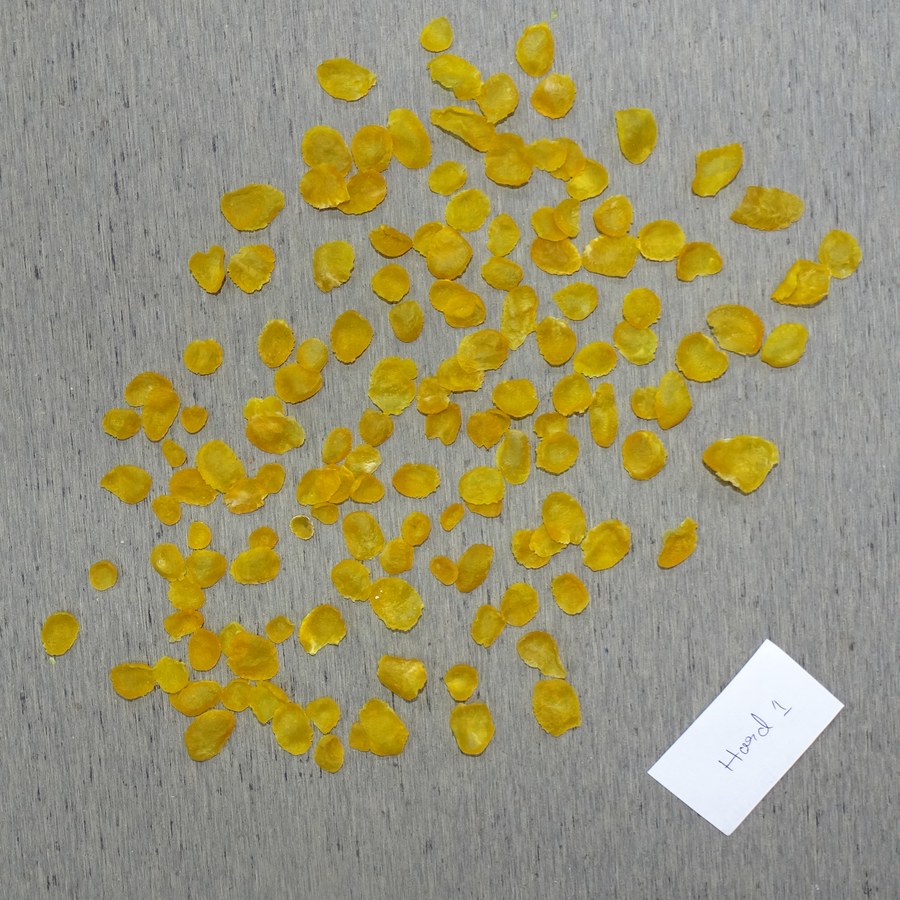
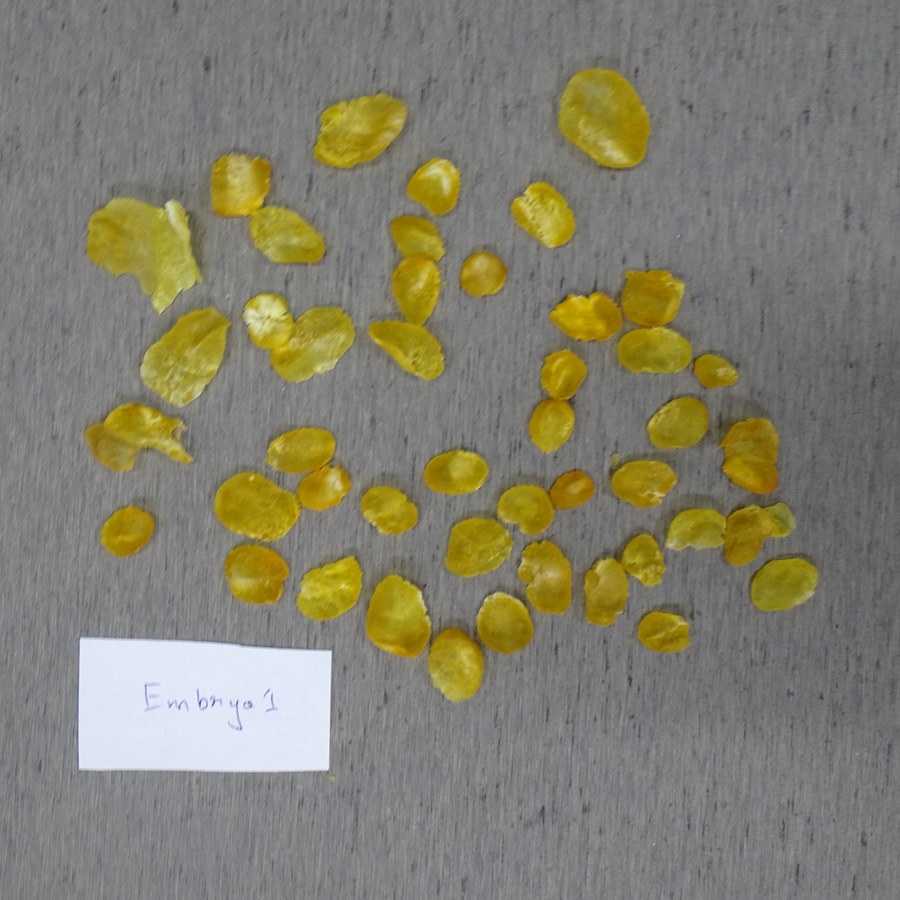
The master reference: 7 grades
Grade
Definition
Target
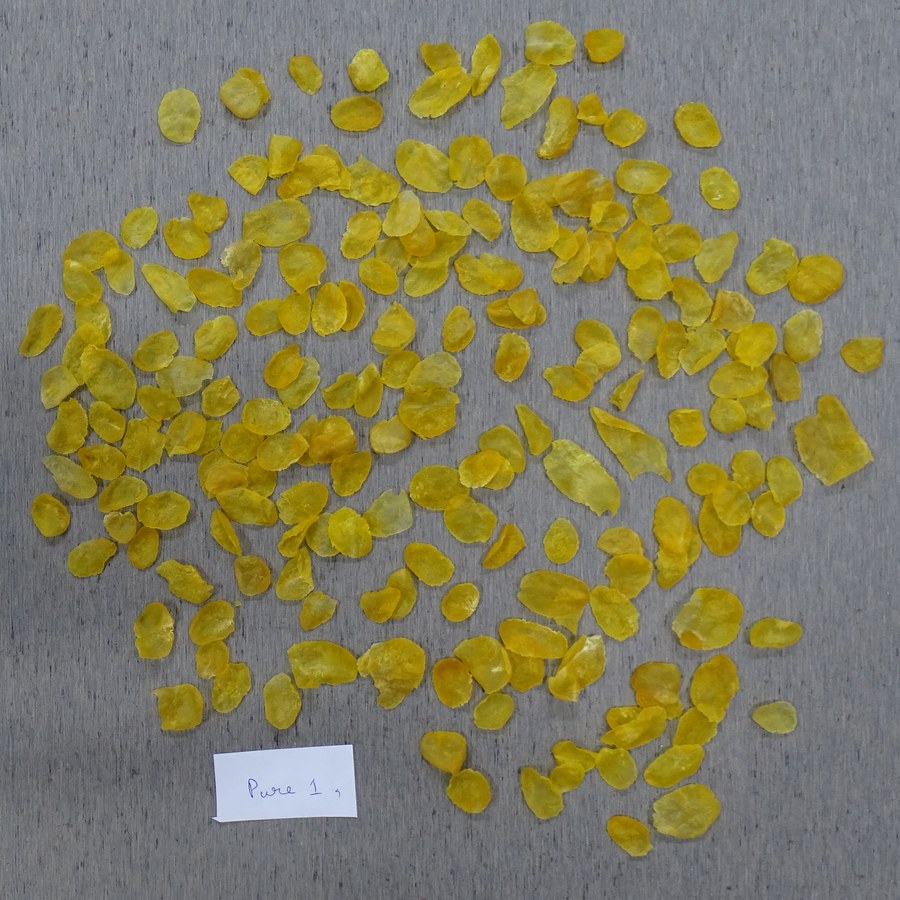
Pure
Well-formed, uniform golden flake
61.1%
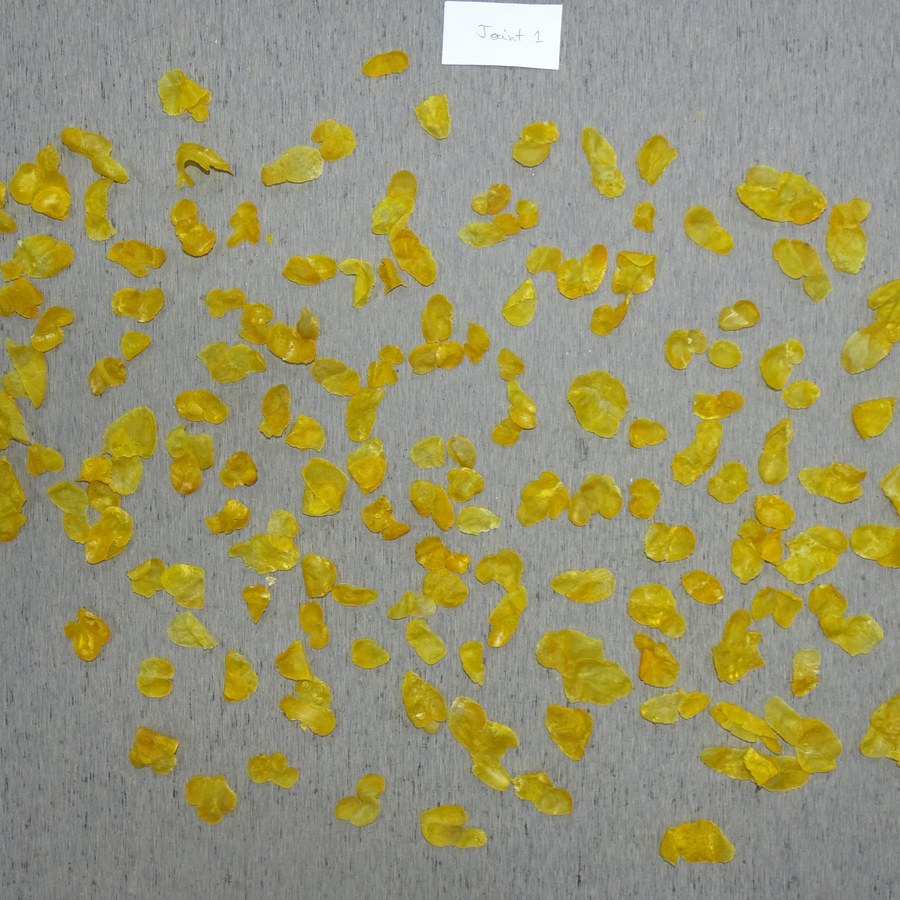
Joint
Two or more flakes fused
11.9%
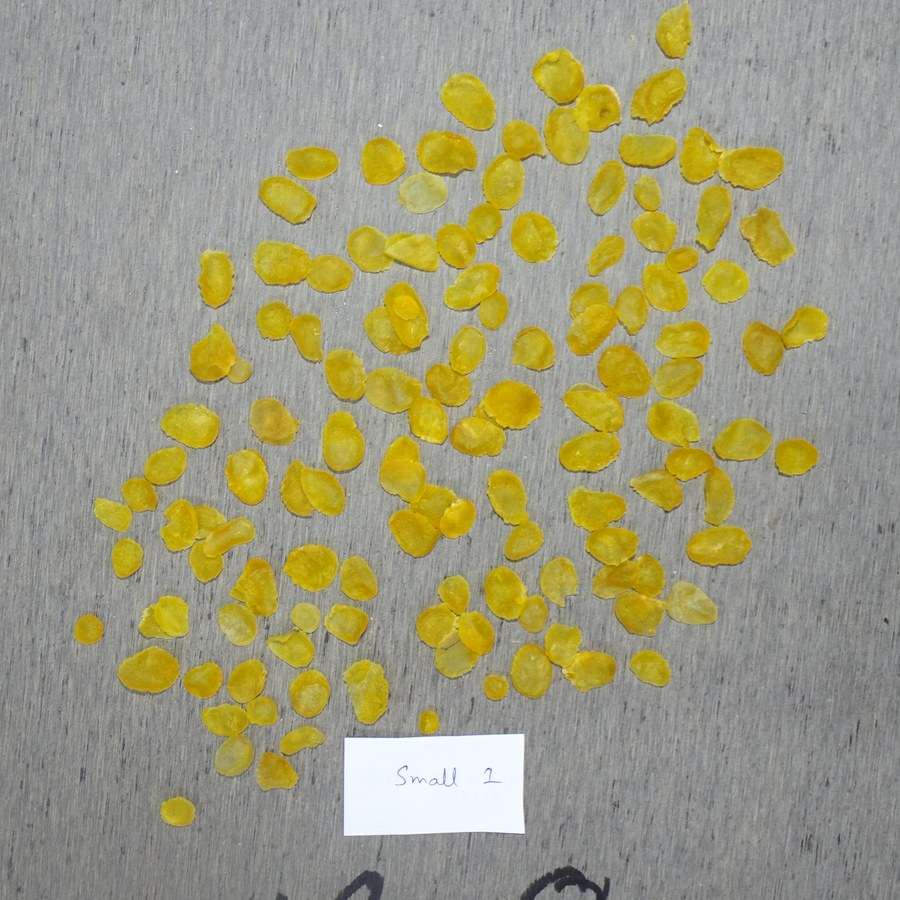
Small
Undersized flake
11.0%
Unpolished
Dull / incompletely polished surface
5.5%
Hard
Over-processed, deep-coloured
5.4%
Embryo
Pale germ tissue attached
3.1%
Broken
Fragmented / broken piece
2.0%
Pure
Joint
Small
Unpolished
Hard
Embryo
Grade photos: your labelled reference piles
Already working on your sample
660 flakes, each one graded
Grade
Sample
Master
Pure
68.0%
61.1%
Joint
5.2%
11.9%
Small
9.7%
11.0%
Unpolished
7.9%
5.5%
Hard
8.5%
5.4%
Embryo
0.2%
3.1%
Broken
0.6%
2.0%
From a 1280×720 phone photo with no reference object. Full interactive report with every flake's measurements: flakegrade-bhagyalakshmi.pages.dev/report
FlakeGrade CV engine v0.3
Part 2
Under the hood
The imaging, geometry, colour science, statistics and edge-deployment engineering behind every number in the report.
● In the POC today● Production build
System architecture
An eight-stage vision pipeline
Each frame flows through deterministic, versioned stages. Every intermediate result is inspectable — nothing is a black box.
01
Acquisition
Fixed-geometry camera, diffuse LED, locked exposure & white balance
Coefficients estimated once at install from a checkerboard (Zhang's method), then every frame is undistorted so edge flakes measure as accurately as centre flakes.
Flat-field correction
Icorr = (Iraw − D) · mean(F − D) / (F − D)
A dark frame D and a flat white frame F remove lighting fall-off and vignetting — essential for colour grades like Hard and Unpolished.
Colour constancy
A reference colour card in frame fixes white balance and exposure per session, so a "deep-coloured" flake means the same thing on every shift, under any factory lighting.
POC today: scale assumed from the sheet width (A1, 841 mm → 0.674 mm/px on the 1280-px photo).
Calibration is performed once at installation
Stage 03 · Colour science In POC
Measuring colour the way the eye does
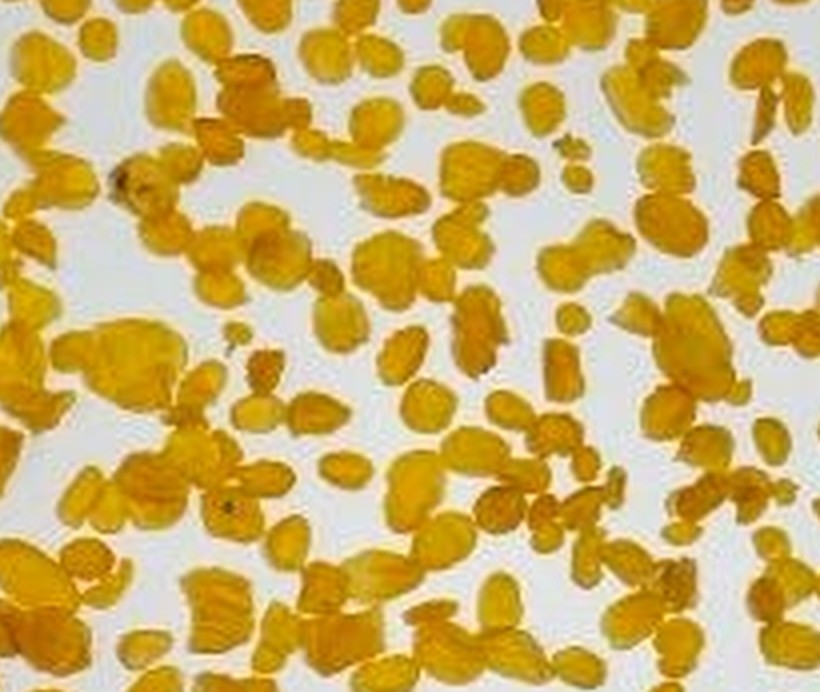
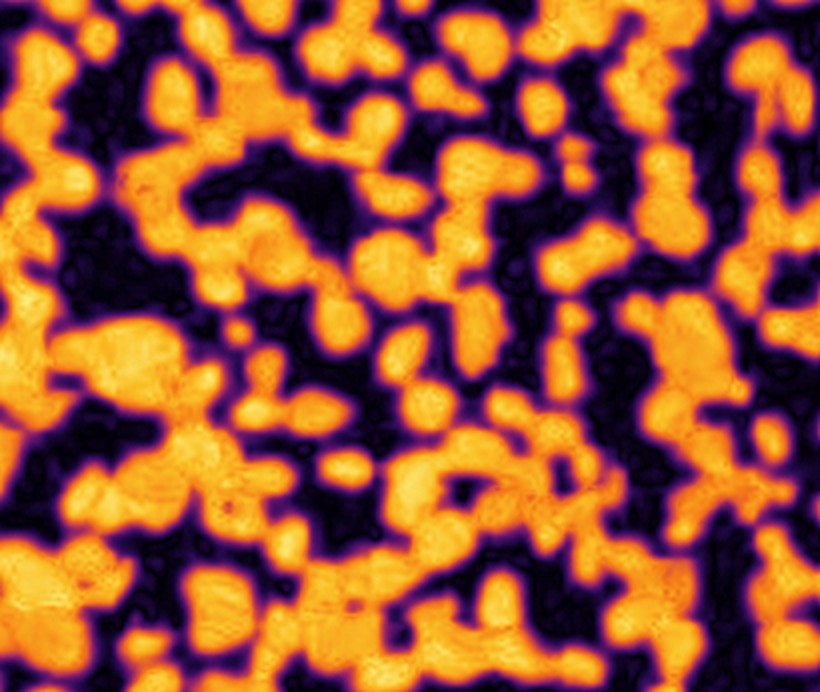
RGB is device-dependent and perceptually uneven. Every pixel is converted to CIELAB, where equal numeric distances are equal visible differences.
C* separates golden flake from white sheet — and dull (Unpolished) from glossy
h constrains to the yellow–orange band (40°–105°)
1Input region (sRGB)
2Computed chroma field C* — flakes glow, sheet goes dark
Real outputs from your 19 Oct sample
Stage 04 · Segmentation In POC
Separating flake from surface
Region of interest
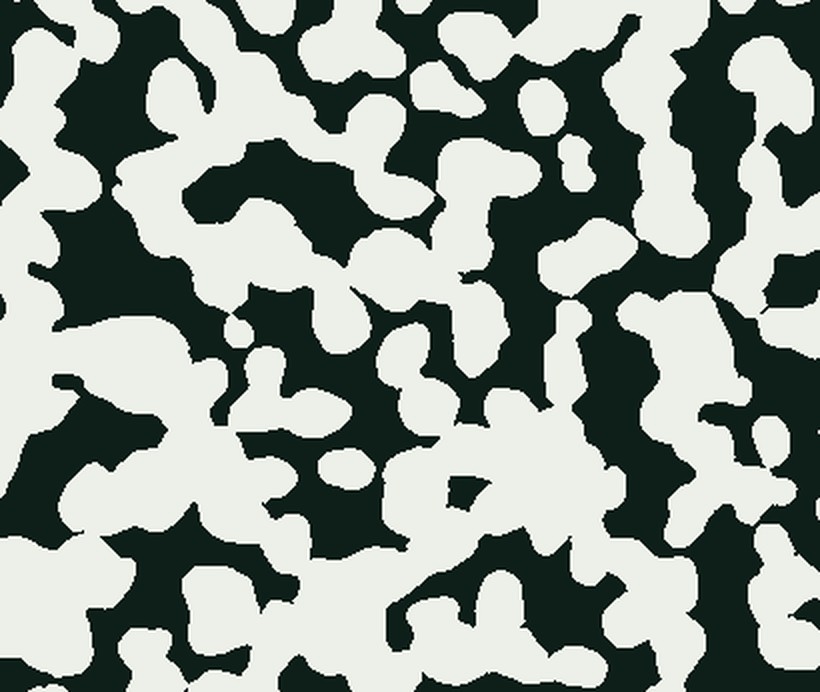
The sample surface is found as the largest low-saturation connected component; morphological closing and hole-filling define the tray. Hands, table and labels outside it are excluded.
LCh gating
M(x) = [C* > 30] ∧ [40° < h < 105°] ∧ [25 < L* < 92] ∧ ROI
Followed by morphological opening (3×3, 2 iterations) to cut thin bridges between touching flakes.
Chroma-aware hole filling
Interior holes are filled only if small and cream-coloured (C* > 11 — germ tissue). White gaps enclosed by a ring of flakes stay open, so empty space is never counted as a fused "joint".
2Chroma field
3Binary flake mask M(x)
Real outputs from your 19 Oct sample
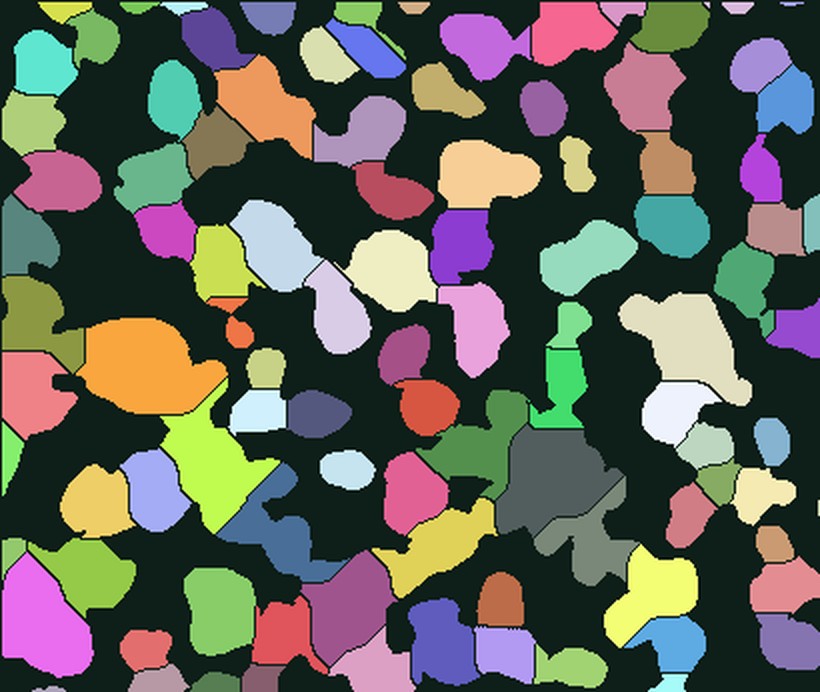
Stage 05 · Instance separation In POC
Counting touching flakes exactly once
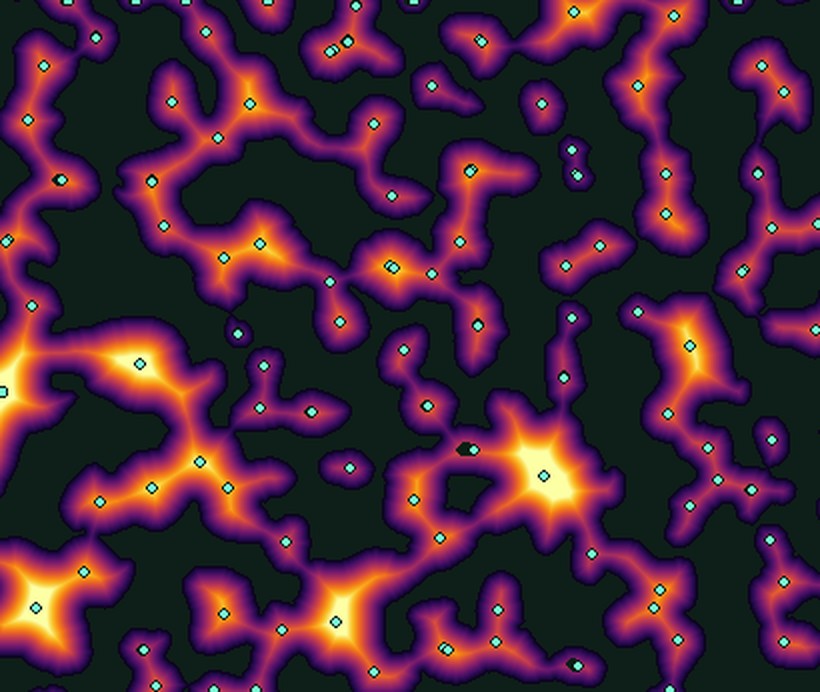
The hardest problem in flake counting: piles touch. A connected blob may contain several flakes. We split them geometrically.
1 · Which blobs need splitting?
split ⟺ A > 1.6·Â ∨ A / Ahull < 0.86
 = robust single-flake area (45th percentile); low solidity reveals the "waist" where two flakes meet.
2 · Euclidean distance transform
D(p) = minq ∉ M ‖p − q‖₂
Each flake body becomes a peak; necks become valleys. Local maxima with D > 0.42·r̂ become seeds.
3 · Geodesic seeded growth
Seeds grow simultaneously inside the blob until they meet, partitioning it along the necks — every pixel assigned, none lost.
3Mask
4Distance transform + seeds
5Instance labels
6Graded output
Real outputs from your 19 Oct sample · 571,085 mask pixels → 660 instances, 0 pixels lost
Stage 06 · Per-flake geometry In POC
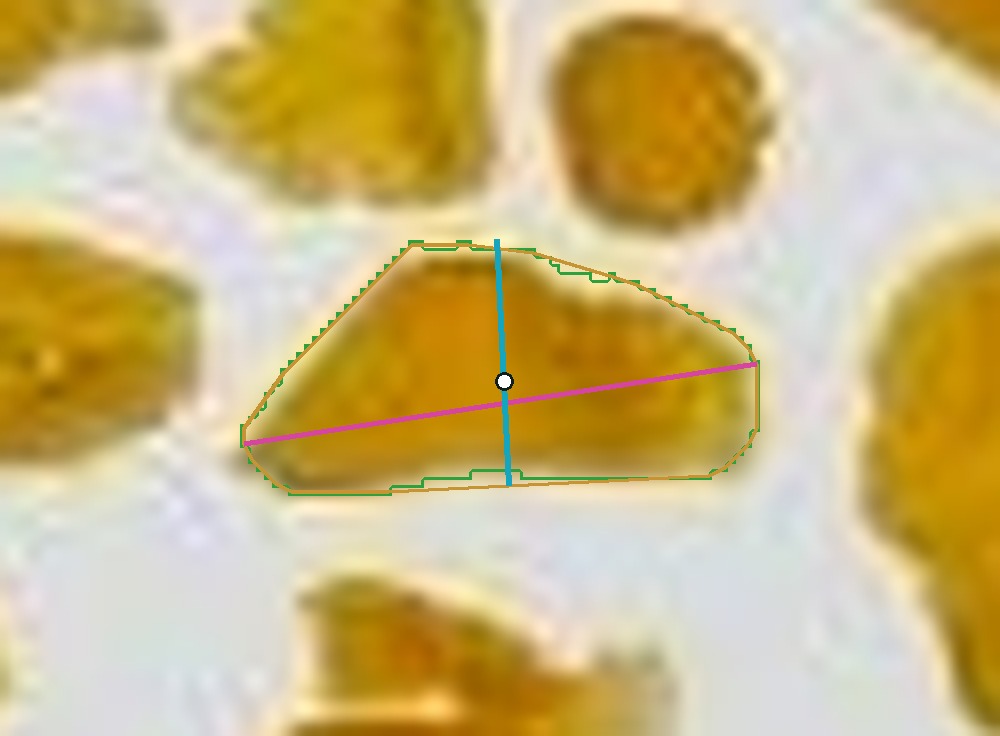
Measuring a single flake
Flake #456 · — max Feret · — min Feret · — convex hull
Descriptor
Definition
#456
Length
max Feret (rotating calipers on hull)
21.8 mm
Width
min Feret over hull edges
10.4 mm
Eq. diameter
√(4A / π)
14.8 mm
Area
pixel count × (mm/px)²
170.9 mm²
Solidity
A / Ahull
1.00
Circularity
4πA / P² (Crofton perimeter)
0.77
Aspect ratio
Feretmax / Feretmin
2.10
Solidity flags fused pairs and ragged fragments; circularity separates broken pieces from whole flakes; Feret length drives the Small grade and is printed on each flake.
Computed by the FlakeGrade engine for one flake in your sample
Stage 06 · Colorimetric & texture descriptors In POC
To know Pure (≈61%) within ±3 points at 95% confidence: n ≈ 1,015 flakes → about two trays per batch. Within ±4 points: ≈ 571.
Count → weight
Lab grading is by weight. Per-grade mean flake mass (from your weigh-method calibration) converts count shares into weight shares.
Accept / reject as a test
Reject only when the interval — not just the point estimate — crosses your limit. Fewer false rejections of good batches.
Intervals computed from the 660-flake sample
Reliability engineering
Deterministic, auditable, and on-site
In POC
Determinism
key = SHA-256(image) ∥ pipeline_version
The same image always returns the identical result — verified by repeat uploads. Results only change on a deliberate, versioned upgrade.
In POC
Full audit trail
Every flake is logged: id, coordinates, length, width, solidity, circularity, L*a*b*, the rule that fired and the engine version — exportable as CSV / JSON for QA records.
Production
Edge inference
Model exported to ONNX, accelerated with TensorRT on the station GPU
FP16 / INT8 quantisation for low latency
Target: full tray graded in seconds
Zero network egress — no cloud, no internet
Continuous improvement loop
Low-confidence flakes are queued for QA review → confirmed labels feed periodic retraining → each new model is validated against a held-out set and released as a new pipeline version, with drift monitoring on the grade mix.
FlakeGrade · Svayou
Part 3
Delivering it on-site
The capture station, the honest state of play, and the path to production.
On-premise architecture
Your data never leaves the plant
Inside your plant
Camera + lighting
Fixed above the sample tray
›
Edge PC (GPU)
FlakeGrade model & app
›
Touchscreen
One-click Scan → report
Local quality log
Every report stored on site
No cloud
No internet needed to grade
Images never leave site
Your data never trains outside models
No per-scan fees
FlakeGrade · Svayou
Capture station · for your procurement
What to buy
Component
Suggested specification
Indicative ₹
Edge PC
Intel i5/i7, 16–32 GB RAM, 512 GB SSD, NVIDIA RTX 4060 (8 GB) — or Jetson Orin NX 16 GB
 Your 19 Oct sample — every flake detected, measured and graded
 Pure
 Joint
 Small
 Unpolished
 Hard
 Embryo
 1Input region (sRGB)
 2Computed chroma field C* — flakes glow, sheet goes dark
 3Binary flake mask M(x)
 4Distance transform + seeds
 5Instance labels
 Flake #456 · — max Feret · — min Feret · — convex hull